
The GDCh Conference on Inorganic Chemistry brought the German inorganic chemistry community to Jena from 7 to 9 September 2026. Organised by the Wöhler Association for Inorganic Chemistry and the Division of Solid-state Chemistry and Materials Research of the German Chemical Society, the meeting covers the breadth of the field, from molecular chemistry to solid-state materials.
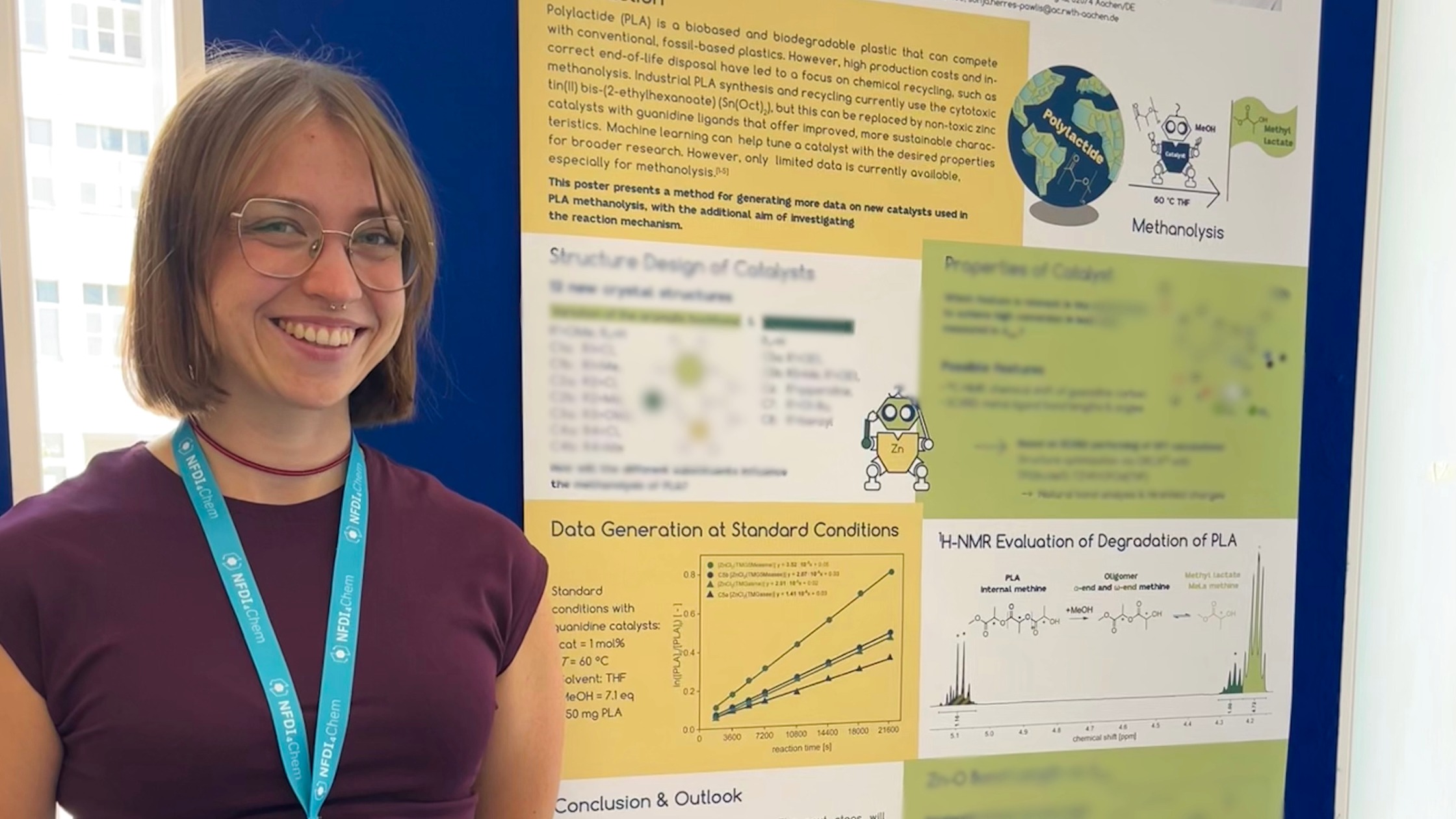
Eveline Jagla, from the group of Professor Sonja Herres-Pawlis at RWTH Aachen University, presented a poster there on work carried out within UPCYCLE, titled Structure-Property Relationships of New Zinc Guanidine Complexes in the Methanolysis of Polylactide.
Catalysts for a Circular Plastic
The poster deals with the chemical recycling of polylactide, better known as PLA, one of the bio-based plastics already used in packaging. Reacting it with methanol breaks it back down into a building block that can be used to make new material, and how well that works depends on the catalyst. The zinc-based catalysts studied in Aachen are designed for that step, and catalysts of this type can work in both directions, building PLA as well as taking it apart.
Why This Matters for UPCYCLE
UPCYCLE aims to develop packaging materials that combine performance, recyclability, and controlled biodegradability. Achieving that goal requires not only new materials, but also efficient ways to recover and reuse them at the end of their life.
The work presented in Jena focused on one of the key pieces of that puzzle: catalysis. By understanding how zinc-based catalysts influence the breakdown and rebuilding of PLA, researchers can help make chemical recycling more efficient and selective.
This research highlights how fundamental chemistry can support the development of circular packaging solutions. Recovering valuable building blocks from materials such as PLA is an important step towards keeping resources in use for longer and reducing dependence on virgin raw materials.