The UPCYCLE project was represented at the European Congress on Biotechnology (ECB2026), held from 28 June to 1 July in Antwerp, Belgium, one of Europe’s key events bringing together researchers and industry working at the forefront of biotechnology.
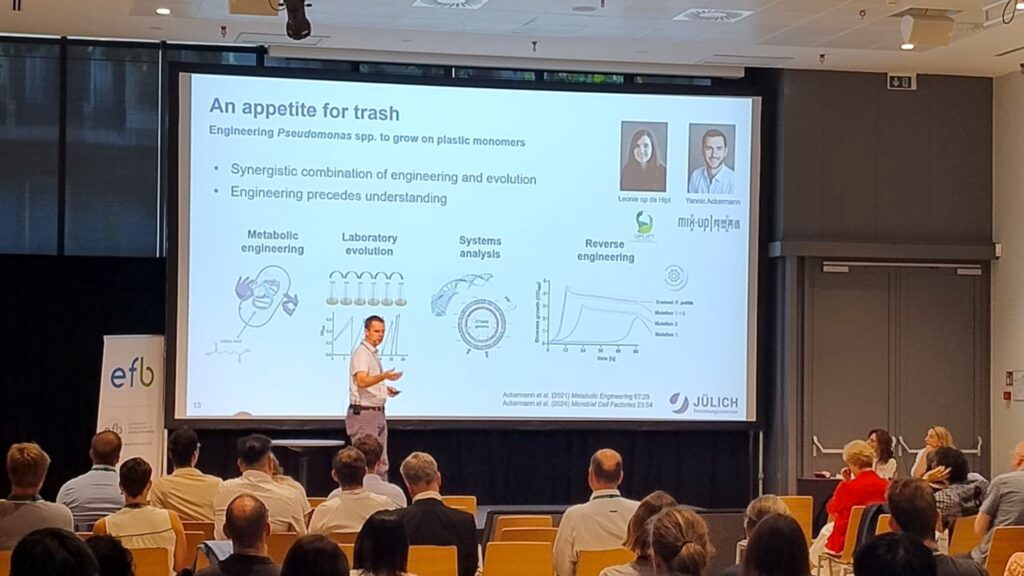
UPCYCLE was represented through the participation of the project partner Nick Wierckx from Forschungszentrum Jülich, who joined the programme as a keynote speaker in the stream “Manufacturing with microbes.”
His talk, titled “Closing cycles in the plastics bioeconomy with biotechnology,” was delivered within Symposium 19: Bioprocess engineering, valorisation and upcycling, and focused on how biotechnology can be applied to reshape material production systems.
The presentation, based on results from the project, explored how microbial catalysis and industrial biomanufacturing can be used to convert plastic-derived streams into valuable chemical building blocks. By engineering microorganisms, these processes enable alternative production routes that support the closing of material cycles in the plastics bioeconomy.
This approach is closely aligned with UPCYCLE’s work, where microbial systems are used to transform plastic-derived intermediates into new materials. The use of biotechnology allows targeted conversions that are difficult to achieve through conventional processes, opening up more flexible and potentially lower-impact pathways.
The session also included contributions on microbial upcycling, fermentation processes, and bio-based chemical production, placing these developments within a broader context of industrial biotechnology applications.
Participation in ECB2026 highlights the role of biotechnology in supporting circular approaches for plastics and reinforces the relevance of combining biological and chemical processes to develop more sustainable material systems.